Il mio progetto filosofico
Questo spazio ospita anche una ricerca filosofica che porto avanti da anni. Non è un sistema già concluso e non pretende di esserlo. È un lavoro in corso: un tentativo di ripensare alcune categorie fondamentali con cui descriviamo la realtà, l’esperienza e il rapporto tra ciò che è possibile, ciò che è necessario e ciò che accade davvero.
This space also hosts a philosophical inquiry I have been developing for years. It is not a completed system, nor does it claim to be one. It is a work in progress: an attempt to rethink some of the fundamental categories through which we describe reality, experience, and the relationship between what is possible, what is necessary, and what actually occurs.
La crepa che ho individuato nella filosofia contemporanea (ma in realtà nella filosofia di sempre) è questa: la metafisica non sparisce mai. Cambia maschera. Ogni volta che diciamo “solo i fatti”, stiamo già decidendo che cosa vale come fatto. Ogni volta che diciamo “conta l’interpretazione”, stiamo già dicendo che cos’è il mondo che interpreta. Anche quando la filosofia si proclama “anti-metafisica”, porta con sé una metafisica implicita: un’idea di realtà, di verità, di causalità, di tempo, di soggetto. Solo che non la dichiara. La nasconde nelle procedure, nel lessico, nelle esclusioni. Questa è la fenditura: la filosofia pretende di descrivere il reale, ma spesso non vede i propri presupposti ontologici, oppure li tratta come ovvietà.
The fracture I have identified in contemporary philosophy — and, in truth, in philosophy as such — is this: metaphysics never disappears. It simply changes its mask. Whenever we say “only the facts,” we have already decided what counts as a fact. Whenever we say “interpretation matters,” we have already implied what kind of world is being interpreted. Even when philosophy presents itself as “anti-metaphysical,” it still carries an implicit metaphysics: an idea of reality, truth, causality, time, and subjectivity. It simply leaves these assumptions undeclared, hiding them in procedures, language, and exclusions. This is the fissure: philosophy claims to describe reality while often remaining unaware of its own ontological presuppositions, or treating them as self-evident.
Da qui nasce un secondo problema, più tecnico ma decisivo: la tradizione occidentale oscilla tra due tentazioni opposte. Da un lato ridurre il reale a ciò che è misurabile, determinato, governato da leggi (il mondo come necessità). Dall’altro dissolverlo in prospettive e linguaggi senza struttura vincolante (il mondo come possibilità infinita). Entrambe le posizioni colgono qualcosa di vero, ma entrambe, prese da sole, lasciano fuori una parte essenziale dell’esperienza: il fatto che il mondo si presenti come tensione tra apertura e limite, tra ciò che potrebbe essere e ciò che insiste, tra ciò che si può immaginare e ciò che accade.
From here emerges a second problem, more technical but decisive. Western philosophy has long oscillated between two opposing temptations. On one side, reducing reality to what is measurable, determined, and governed by laws (the world as necessity). On the other, dissolving it into perspectives and languages without binding structure (the world as infinite possibility). Both positions grasp something true, yet taken alone they leave out an essential dimension of experience: the fact that the world presents itself as a tension between openness and limit, between what could be and what insists, between what can be imagined and what actually happens.
Il progetto che attraversa la mia ricerca nasce da qui. Non come costruzione di un nuovo sistema chiuso, ma come tentativo di un’ontologia capace di pensare insieme movimento e forma, apertura e necessità, libertà e vincolo, senza far collassare tutto in uno dei due poli. L’ipotesi di fondo è che la realtà non sia un blocco immobile né un flusso indifferenziato, ma una struttura dinamica in cui ciò che può essere, ciò che deve essere e ciò che diventa reale si implicano reciprocamente. Non sono tre “zone” separate: sono tre aspetti intrecciati dello stesso fenomeno, che si lasciano capire solo se li si tiene insieme.
The project that runs through my research begins at this point. Not as the construction of a new closed system, but as an attempt toward an ontology capable of thinking movement and form, openness and necessity, freedom and constraint together, without collapsing everything into one of these poles. The underlying hypothesis is that reality is neither a static block nor an undifferentiated flow, but a dynamic structure in which what can be, what must be, and what becomes real mutually imply one another. These are not three separate “domains,” but intertwined aspects of the same phenomenon, intelligible only when held together.
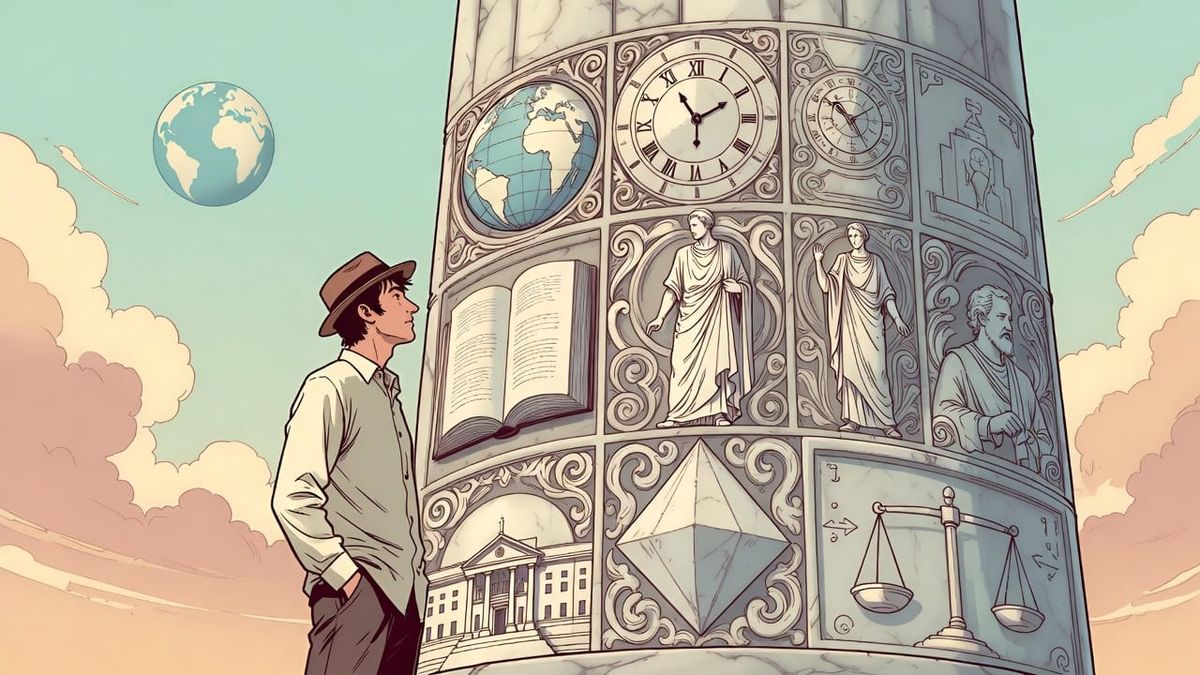
Finora non ho pubblicato nulla, né ho sottoposto anche solo parzialmente queste ipotesi a un pubblico di specialisti. Ogni nuovo tassello richiede una revisione continua delle parti precedenti, con cui deve armonizzarsi. E così resto in bilico tra visione globale e dettaglio: come quando si osservano i bassorilievi di una colonna e, per cogliere la figura, bisogna girarle intorno, perdendo ogni volta ciò che sembrava acquisito.
So far, I have published nothing, nor have I submitted these ideas, even partially, to a specialist audience. Each new element requires a continuous revision of what came before, and must be brought into coherence with it. I therefore remain suspended between the overall vision and the particular detail — as when observing the bas-reliefs of a column: in order to grasp the figure, one must move around it, losing each time what seemed already understood.
Per questo la mia scrittura non procede soltanto per trattati, anche se tende verso una forma più compatta. E attraversa storia, letteratura, politica, vita quotidiana. Perché se un’ontologia vuole essere più di un gioco di concetti, deve passare la prova del mondo: deve saper leggere le aporie reali, quelle che generano teorie e poi le incrinano. Qui, quindi, non troverai un sistema già impacchettato, ma una ricerca: appunti, tentativi, verifiche, deviazioni. Un laboratorio che prova a dire la metafisica invece di farla di nascosto.
That's why my writing does not proceed only through systematic treatises, even if it tends toward a more compact form. It also moves through history, literature, politics, and everyday life. If an ontology is to be more than a game of concepts, it must pass the test of the world: it must be able to read real aporias, the ones that generate theories and then fracture them. What you will find here, therefore, is not a finished system but a research process — notes, attempts, verifications, deviations. A workshop that tries to make metaphysics explicit rather than practicing it unconsciously.
Patto di lettura: se ti interessa seguire una costruzione concettuale mentre si costruisce (con le sue correzioni, riprese e ripensamenti), questa pagina è la soglia. Se cerchi una dottrina già chiusa, qui troverai soprattutto una cosa più onesta: il lavoro.
A reading pact: if you are interested in following a conceptual construction while it is still being built — with its revisions, returns, and reconsiderations — this page is the threshold. If you are looking for a closed doctrine, what you will find here instead is something more honest: the work itself.